Executive summary
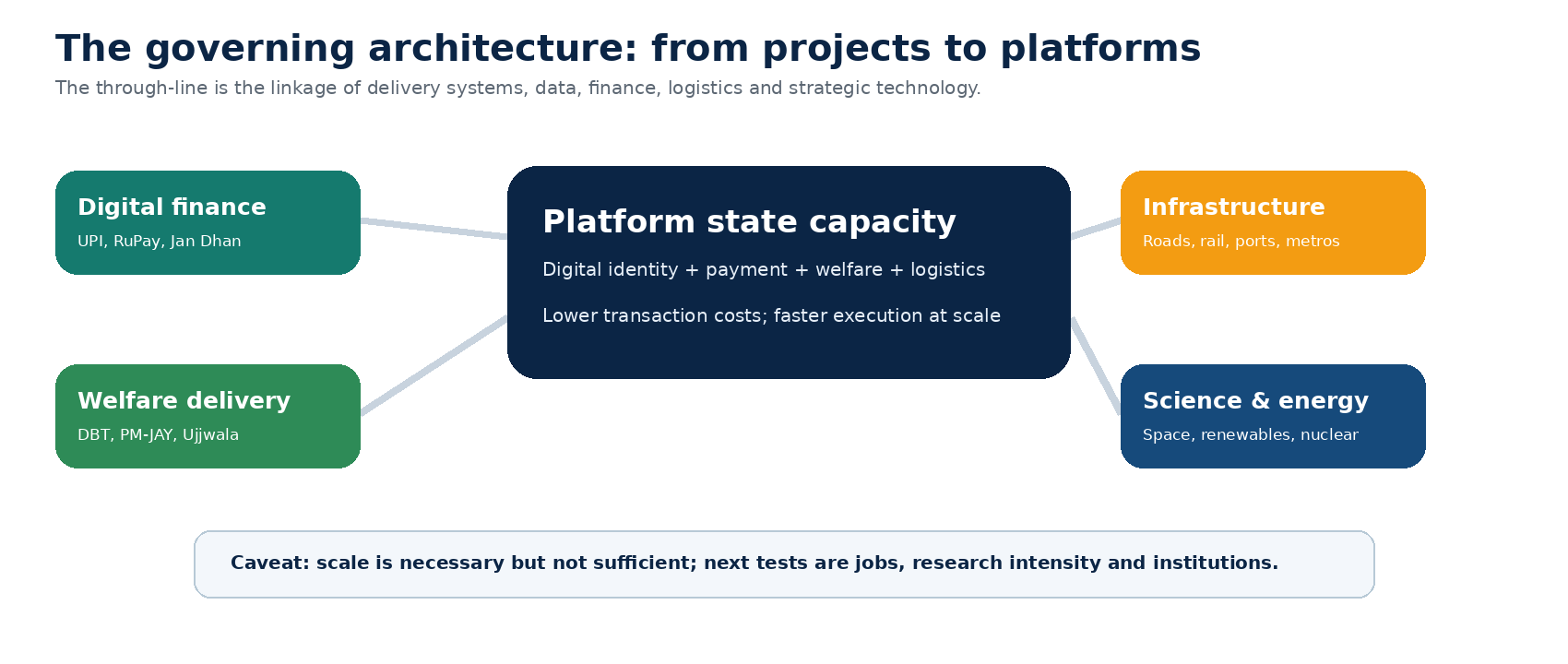
The strongest achievement of the Modi years is a state-capacity story. India built and scaled digital payment rails, welfare-delivery rails, logistics networks, space missions, renewable capacity and pandemic-response systems in a way that changed the operating architecture of the state. UPI became a mass public-rail system rather than merely a private fintech story; RuPay and Jan Dhan added domestic payments and financial-inclusion depth; roads, rail electrification, airports, metros and port performance created a more visible infrastructure platform; and ISRO’s lunar, solar, docking and international launch-service milestones gave India greater scientific and strategic visibility. [PIB UPI] [PMJDY] [ISRO]
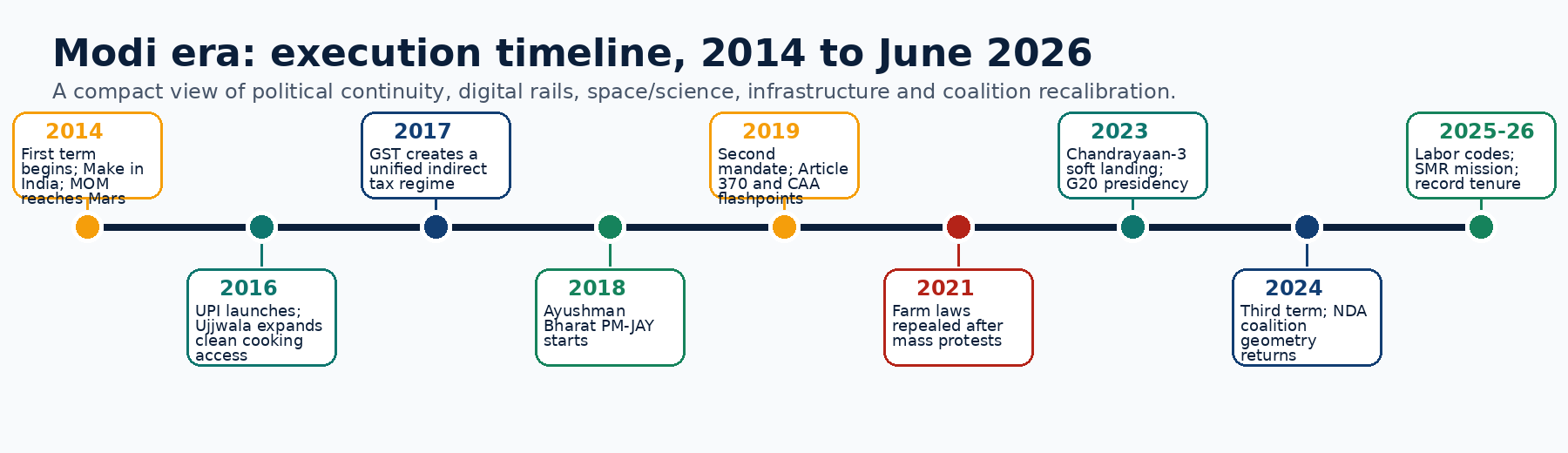
The second achievement is continuity. Modi first took office on 26 May 2014, returned in 2019, and began a third term on 9 June 2024. The first two terms rested on clear BJP majorities; the third term preserved continuity but returned India to a more coalition-mediated parliamentary geometry. That distinction matters because infrastructure, energy and digital systems need persistence across budget cycles, while coalition politics changes the operating model from unilateral dominance toward negotiated continuity. [PMO] [AP]
The fair reading is therefore not that every reform succeeded. Demonetization remains a major policy shock; the farm-law episode ended in repeal after sustained protest; the electoral-bond regime was struck down by the Supreme Court; and credible external assessments have raised concerns about civil liberties, institutional stress and majoritarian politics. At the same time, India remains fiercely electoral and politically competitive, as the 2024 result itself showed. A serious blog should therefore avoid both hagiography and declinism. [Reuters] [SC Observer] [V-Dem]
The most defensible conclusion is that Modi’s India became more infrastructurally capable, more digitally integrated, more internationally visible and more ambitious in strategic science. The next-order questions are whether the scale already built translates into better jobs, deeper manufacturing value capture, stronger research intensity, cleaner institutional trust and higher productivity. By the Government of India’s post-1952 official count, Modi also became India’s longest continuously serving elected prime minister on 10 June 2026, with the important caveat that Nehru served longer overall if the pre-1952 period is included. [PMO]
1. Political economy: continuity, centralization and execution
Modi’s record begins with unusual continuity in a democratic system often shaped by coalition churn. The 2014 election created the first single-party majority in three decades; the 2019 election strengthened that mandate; and the 2024 election returned Modi to office but with the BJP dependent on NDA partners. The consequence is not a change in strategic direction, but a change in parliamentary mechanics: the first decade was strongly centralized; the third term is still centralized but less unconstrained. [PMO] [AP]
The governance style has been mission-mode, brand-centered and administratively centralized. Its strongest empirical evidence is not rhetoric but execution stock: highways, rail electrification, ports, airports, digital payments, Jan Dhan accounts, direct-benefit transfer capability and health/housing delivery all required repeated budgeting and continuous monitoring. Supporters call this decisiveness and delivery; critics see excessive concentration of power. Both judgments arise from the same underlying fact: the center became more operationally assertive. [Roads] [Rail] [PMJDY]
The legislative record is similarly mixed. GST endured as a permanent tax architecture; labor-code consolidation finally moved toward implementation in the third term after a long lag; but demonetization remains heavily disputed, and the farm-law reversal showed that mass protest could still check an aggressive reform push. A good blog should present this as a high-execution model with real feedback constraints, not as a frictionless transformation. [Labor] [Reuters]
Article 370 and J&K security belong in this political-economy section because they show how the Modi government linked constitutional integration, internal security and development delivery. In August 2019 the government moved to repeal the special-status operation of Article 370 and reorganize the former state into the Union Territories of Jammu and Kashmir and Ladakh [Article 370 resolution]. The move remains politically contested: supporters view it as national integration and equal constitutional application, while critics emphasize federalism, civil liberties and local political consent. For analytical balance, the blog should acknowledge both, while noting that the Supreme Court later upheld the constitutional validity of the abrogation [Supreme Court judgment].
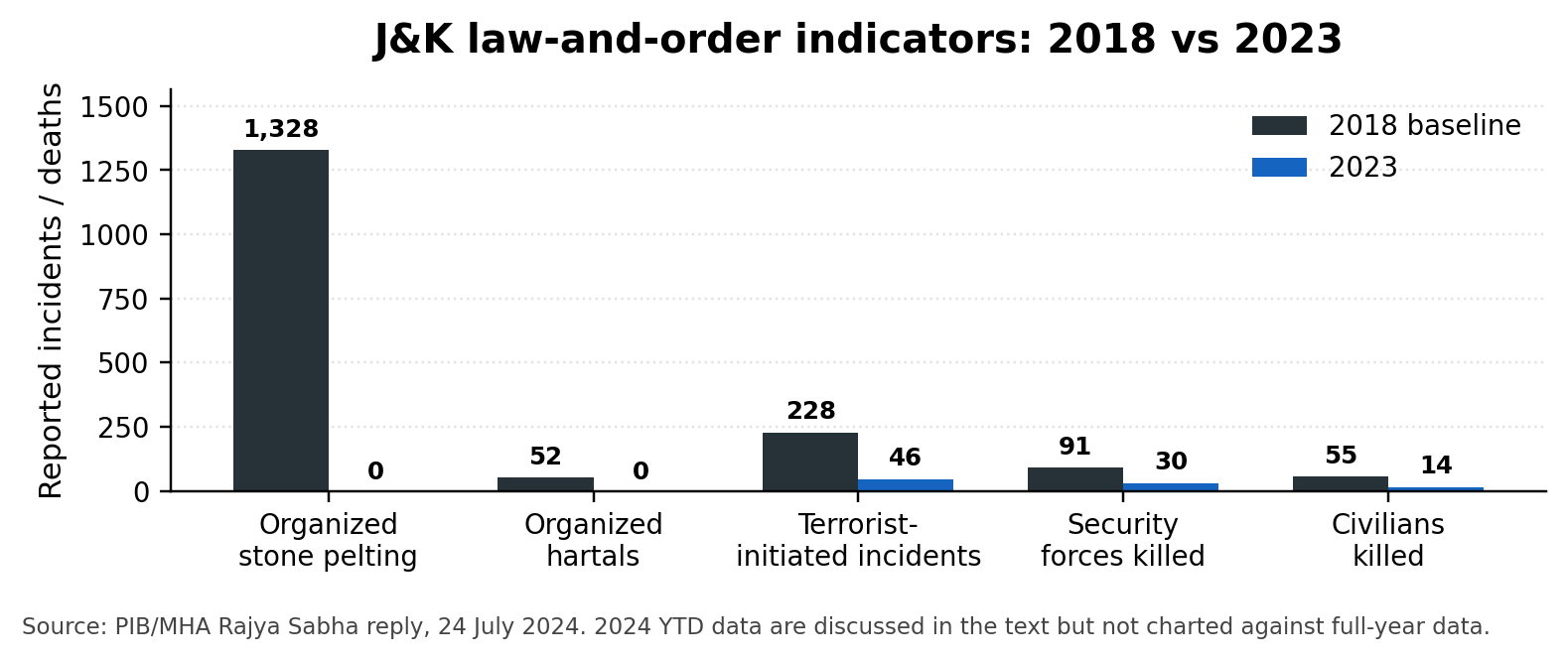
On terrorism and internal security, the strongest measurable point is the decline in official law-and-order indicators. PIB/MHA data reported organized stone pelting at 1,328 incidents in 2018 and zero in 2023; organized hartals at 52 and zero; terrorist-initiated incidents at 228 and 46; security-force deaths at 91 and 30; and civilian deaths at 55 and 14 [J&K law-and-order reply]. The same reply reported 11 terrorist-initiated incidents through 15 July 2024, but that is only a partial-year figure. This does not mean terrorism has been eliminated. It means the state’s operating model shifted toward zero tolerance, tighter counter-terror coordination, action against terror financing and sustained pressure on the ecosystem [MHA counter-terrorism]. In the blog’s thesis, J&K becomes a case study of Modi-era statecraft: constitutional centralization, security hardening and development delivery moving as a single policy package.
2. Digital public infrastructure and welfare rails
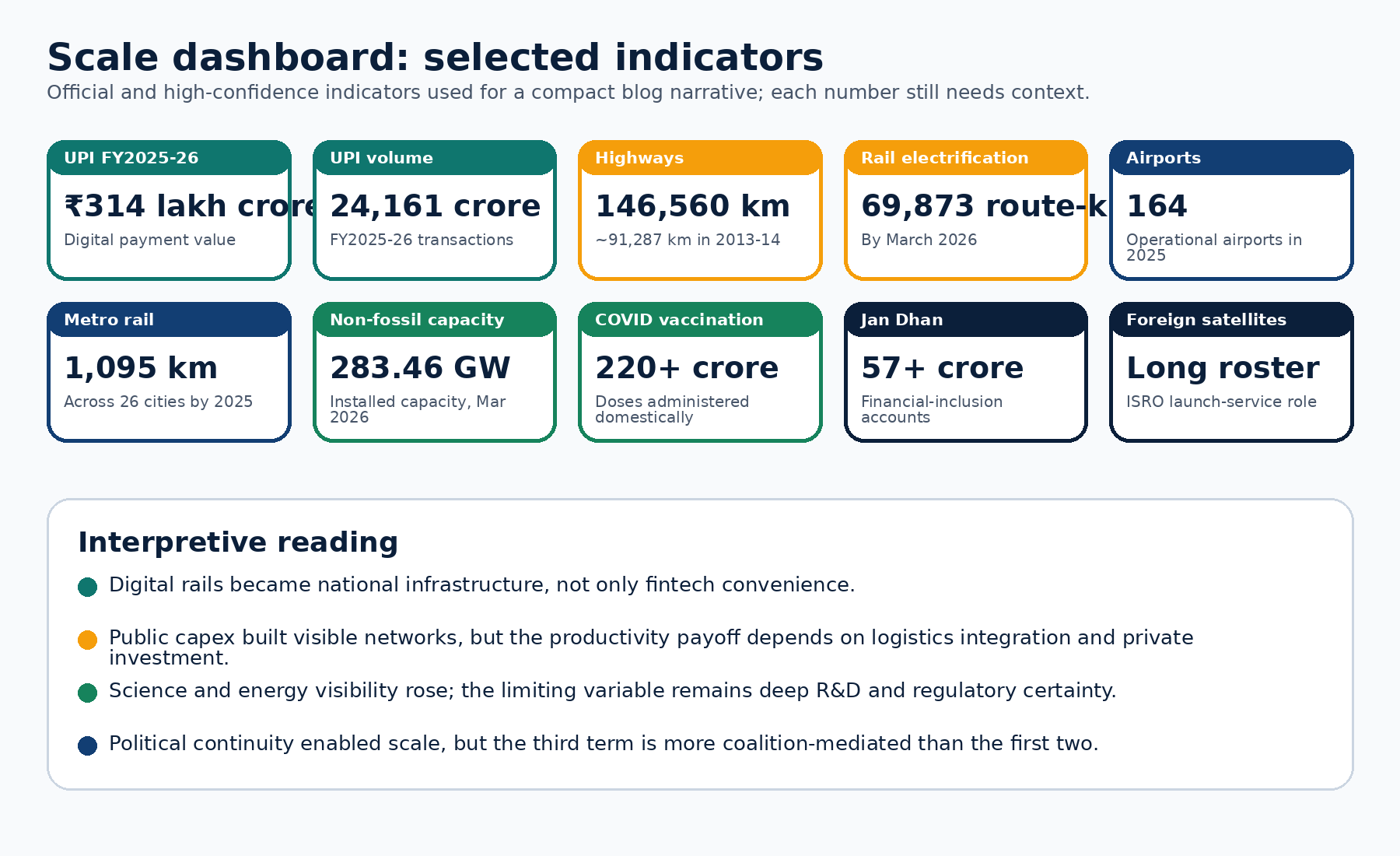
Digital public infrastructure is arguably the most durable domestic achievement. UPI processed more than ₹314 lakh crore in FY2025-26 and became a global case study in real-time payments at scale. The deeper point is architectural: Paytm, PhonePe, Google Pay and other apps matter, but the foundational achievement is the interoperable public rail that private firms and banks can use. This makes the transformation broader than any one consumer brand. [PIB UPI] [NPCI]
RuPay extends the same sovereignty logic into cards. It does not make India independent of the wider global financial system, but it reduces dependence on foreign card networks inside the domestic retail stack and gives policymakers a domestic rail for inclusion-linked products. Jan Dhan accounts, RuPay cards, Aadhaar-linked delivery and mobile connectivity together created the “JAM” base layer for welfare transfer and financial inclusion. [PMJDY] [RuPay]
Welfare delivery scaled through the same operating logic. Jan Dhan broadened account ownership; Ujjwala expanded LPG access for poor households; Ayushman Bharat PM-JAY created a large publicly financed hospitalization architecture; Swachh Bharat pushed sanitation infrastructure; and Digital India plus BharatNet expanded the connective tissue beneath these schemes. These programs still face questions of quality, exclusion, state implementation and usage intensity, but the scale of the delivery machine is difficult to dismiss. [PMUY] [Ayushman] [Swachh] [Digital India] [BharatNet]
3. Economy and infrastructure: public capex as the visible backbone
The macro story is strong but should be written with methodological discipline. India remained one of the fastest-growing large economies, and recent official releases show growth continuing above 7 percent on the revised series. Fiscal policy moved from pandemic stress back toward consolidation, with the Union fiscal deficit framed at 4.4 percent of GDP for FY2025-26 and lower in the subsequent budget path. FDI remained meaningful, but gross and net flows can tell different stories because repatriation and sector composition matter. [MoSPI] [Budget] [DPIIT]
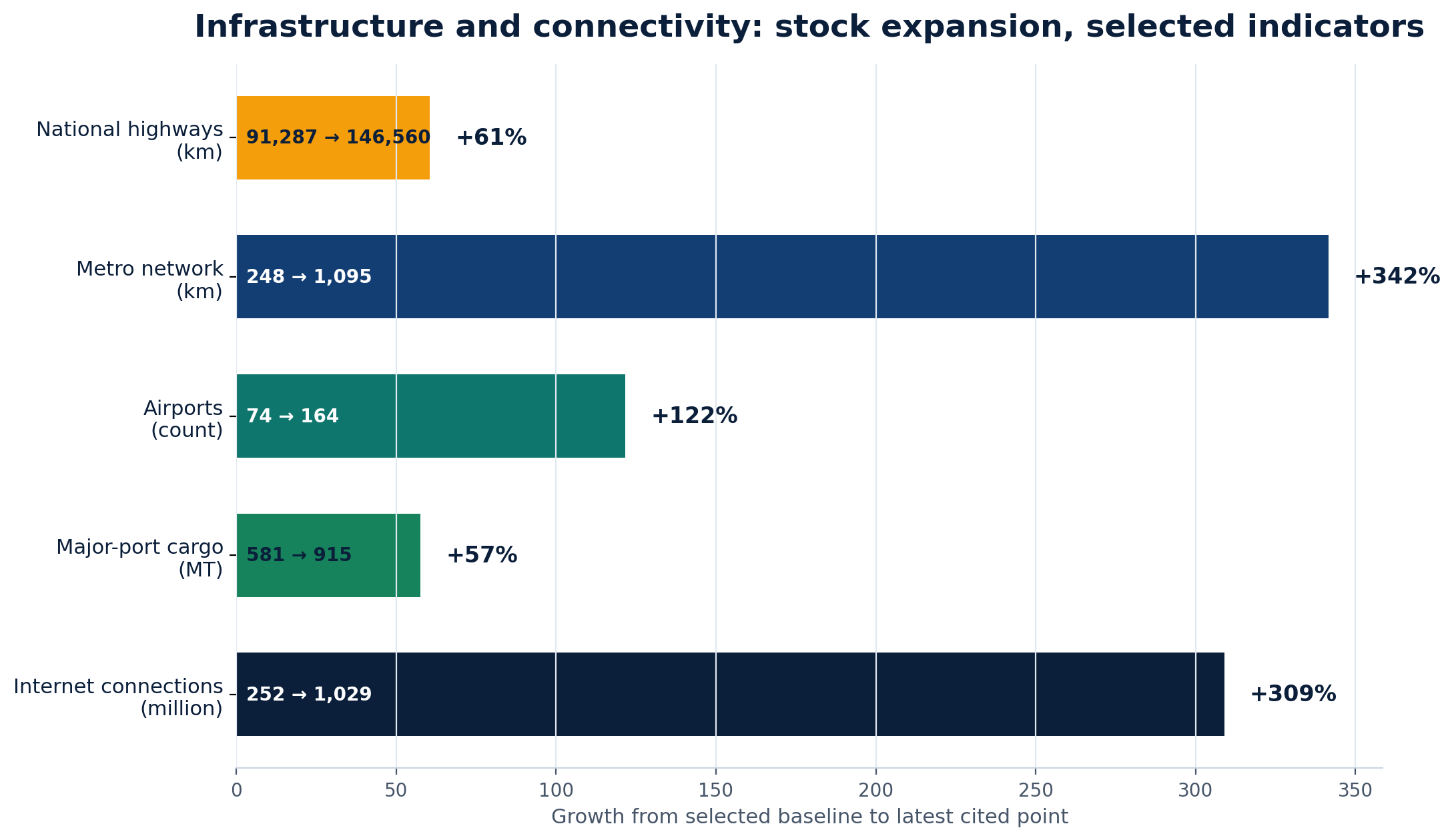
Infrastructure is the most visible part of the record. National highways expanded from about 91,287 km in 2013-14 to roughly 146,560 km by end-2025. Metro rail moved from a small urban base to more than 1,000 km across cities. Airports more than doubled from the 2014 level. Rail electrification moved rapidly toward near-complete broad-gauge coverage, and major-port cargo and turnaround performance improved. These are not symbolic numbers only; they reduce transaction costs if logistics, urban planning and industrial clustering keep pace. [Roads] [Metro] [Airports] [Rail] [Ports]
Manufacturing policy became more activist through Make in India and PLI-style incentives. The strongest positive case is electronics, mobile assembly and selected industrial segments; the skeptical case is that subsidy-led assembly is not yet the same as deep component ecosystems, broad labor absorption or sustained private investment momentum. The right way to frame it is traction without declaring victory. [MoSPI] [DPIIT]
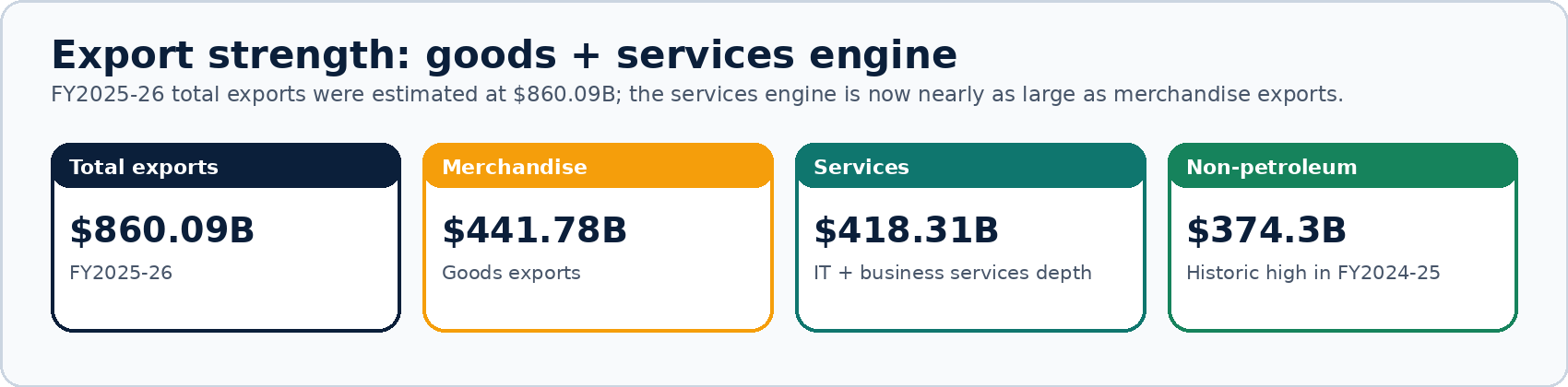
Export strength is now a separate pillar of the economy section. India’s overall exports in FY2025-26 were estimated at US$860.09 billion, with merchandise exports at US$441.78 billion and services exports at US$418.31 billion. The services engine is strategically important because software, business services and professional capabilities generate foreign-exchange resilience even when the merchandise trade deficit remains large. At the same time, non-petroleum exports reached a historic high in FY2024-25, with electronics, pharmaceuticals, electrical machinery and automobiles identified by official sources as major growth drivers. The next test is to move from export volume to deeper value capture: components, design, intellectual property, brands and high-skill manufacturing. [exports] [drivers]
Poverty and welfare outcomes improved substantially in the World Bank’s updated work, but the exact magnitude depends on consumption-survey handling, PPP updates and inequality methodology. A rigorous blog should say poverty reduction appears real and large, while also acknowledging that consumption surveys understate top-end concentration and do not settle the whole inequality debate. [World Bank]
4. Science, space, energy and nuclear ambition
For a scientifically minded reader, the Modi period is rich because state ambition, engineering execution and symbolic politics aligned. The Mars Orbiter Mission reached Mars orbit in September 2014, giving India major prestige even though the mission was conceived and launched before Modi took office. Chandrayaan-3 then supplied the defining symbolic breakthrough: safe lunar soft landing and rover operations. Aditya-L1 placed India into dedicated solar-observatory science, and SpaDeX demonstrated docking capability, a systems milestone relevant to future human-spaceflight and station ambitions. [ISRO MOM] [Chandrayaan] [Aditya-L1] [ISRO 2025]
ISRO’s international launch-service role should not be lost beneath the lunar headline. Its foreign-satellite roster shows India acting not only as a prestige space power but also as a commercial and diplomatic launch provider. That matters strategically because reliability, cost and orbital access are sources of international influence. The caveat is that mission visibility is not the same as national research depth; India still needs stronger university-industry-lab pipelines and higher research intensity to convert symbolic science into sustained technology leadership. [ISRO foreign satellites]
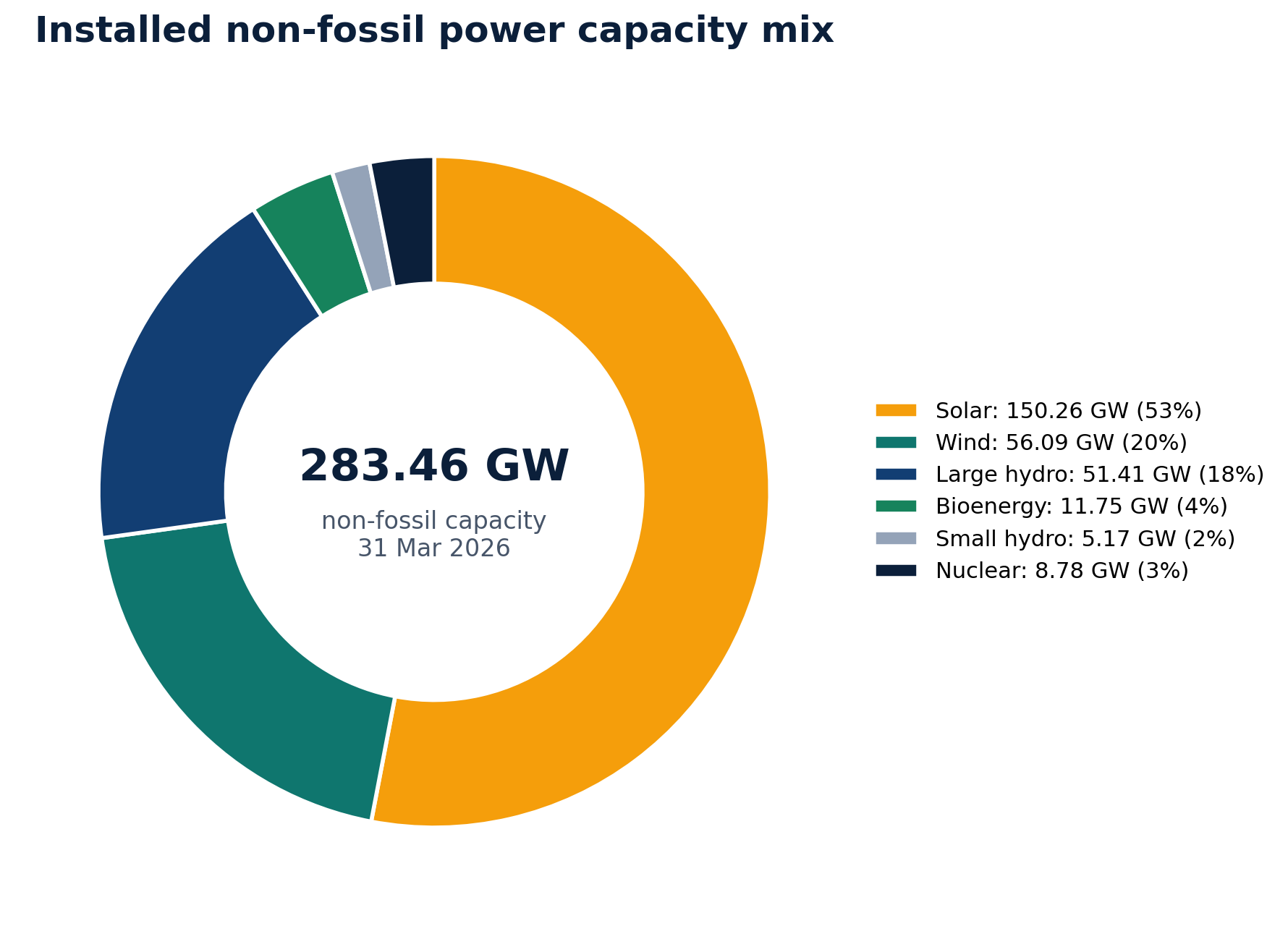
Energy is a dual-track story. India rapidly expanded renewable and non-fossil installed capacity, reaching 283.46 GW of non-fossil installed capacity as of 31 March 2026. Installed capacity is not the same as generation, however, and the IEA still describes India as an economy where coal remains the largest source of energy supply. The accurate conclusion is therefore not that India has decarbonized; it is that India has built a much larger non-fossil platform while still operating inside a coal-heavy growth economy. [MNRE/PIB] [IEA]
Nuclear power illustrates ambition plus constraint. The government has framed a 100 GW nuclear-capacity goal for 2047 and a Nuclear Energy Mission focused on small modular reactors. The NTPC-NPCIL joint-venture structure, including ASHVINI, signals a move toward broader participation. But as the cited policy materials indicate, this is controlled liberalization rather than a fully open market; private and foreign participation still depends on legal, regulatory and liability architecture. [PIB nuclear] [NPCIL JV]
5. India abroad: multi-alignment, BRICS and vaccine diplomacy
Modi’s foreign policy is best described as multi-alignment, not bloc politics. India deepened strategic technology and defense ties with the United States and France, stayed active in the Quad, maintained Russia ties, supported BRICS expansion, and used the G20 presidency and Global South framing to project itself as a bridge power. IMEC was promoted as an alternative connectivity architecture, even though its long-term execution will depend on geopolitics, financing and regional stability. [BRICS] [Quad] [IMEC]
India’s external posture also rests on a stronger border and defence-industrial base. Defence exports reached a record ₹38,424 crore in FY2025-26, while official materials describe continued frontier connectivity through Border Roads Organisation roads, bridges and tunnels. This matters because diplomacy is more credible when backed by hard capacity: surveillance, logistics, all-weather access, domestic defence production and rapid mobilization infrastructure along vulnerable borders. The point should be framed carefully: India has not eliminated border risk, especially on the China and Pakistan fronts, but it has invested in the physical and industrial backbone required to defend its borders with greater confidence. [defence] [BRO] [border security]
Diplomatically, the distinctive achievement is balancing East-West and North-South politics at the same time. India can sit with the Quad and deepen U.S.-Europe technology cooperation, remain in BRICS and the SCO ecosystem, maintain a working relationship with Russia, and still present itself as a voice for the Global South. This is not ideological neutrality; it is issue-based multi-alignment. For a world divided by U.S.-China competition, Russia-West confrontation, energy security and supply-chain risk, India’s value is that it can speak across blocs without fully belonging to any one bloc. [MEA] [Global South]
The pandemic added a diplomatic dimension to state capacity. Domestically, India administered more than 220 crore vaccine doses. Externally, the MEA vaccine ledger records large supplies abroad through grants, commercial channels and COVAX. A balanced account should recognize both the scale of India’s vaccine production/supply role and the severity of the domestic health shock, especially during the Delta wave. [MoHFW/PIB] [MEA]
6. My vision for India’s next decade: leapfrogging from scale to leadership
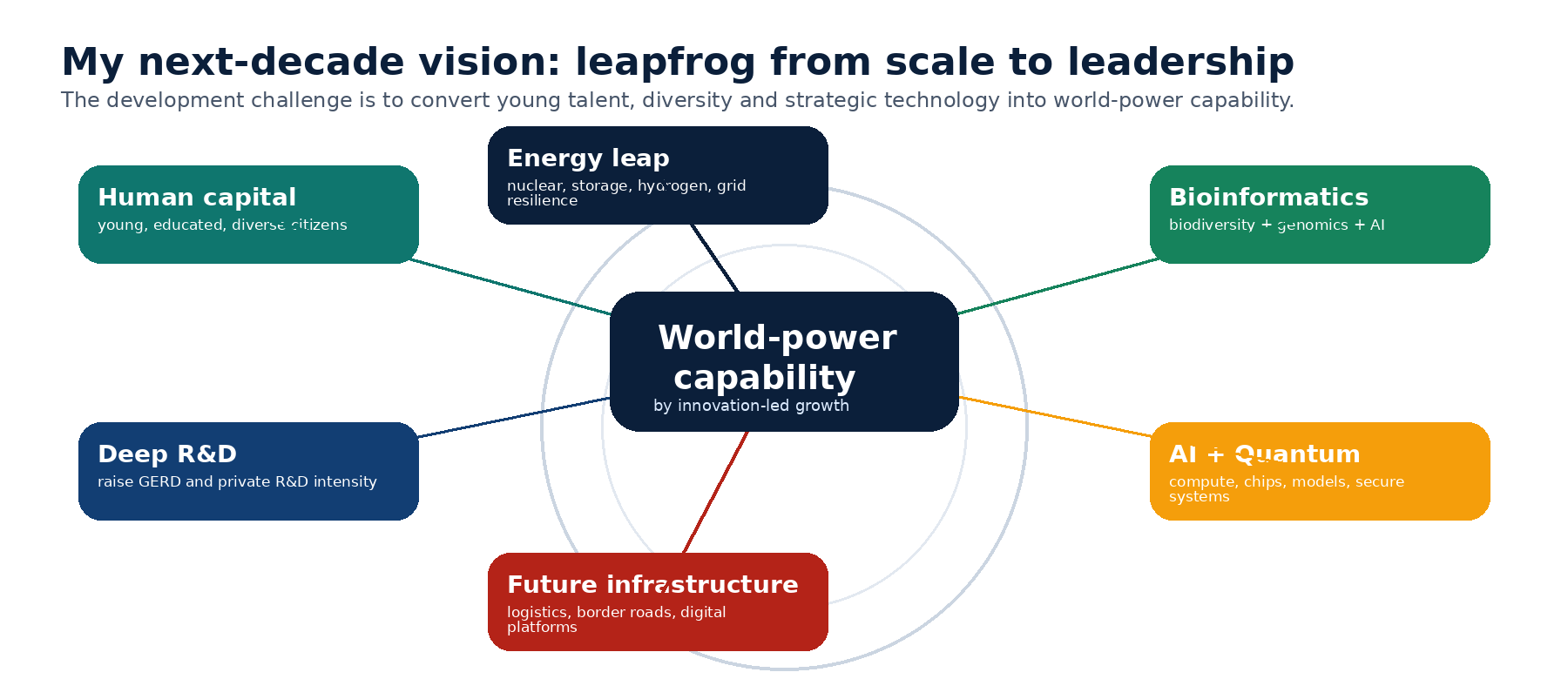
My vision for the next decade is that India should aspire not only to be a large economy, but to become a responsible world power built on knowledge, innovation and civilizational confidence. The demographic base makes this possible: India has a vast young and working-age population, with exceptional linguistic, regional and professional diversity. But demographic dividend is not automatic. It becomes national power only when education, skills, health, manufacturing, research institutions and entrepreneurship convert human numbers into human capability. [UN population] [working age]
India should make bioinformatics and computational biology a strategic priority. Few countries combine India’s scale of biodiversity, traditional knowledge, pharmaceutical capacity, software talent and medical-data potential. India is one of the world’s 17 megadiverse countries and hosts four global biodiversity hotspots. The opportunity is to build privacy-protective national platforms for genomics, biodiversity informatics, drug discovery, agriculture, microbiome science and climate-resilient biology. This would connect India’s natural diversity with its computational talent. [biodiversity]
The largest strategic gap is R&D intensity. DST data show India’s gross expenditure on R&D was about 0.64 percent of GDP in 2020-21, far below what a technology-leading power should accept. The next decade should target a step-change in public and private R&D: AI compute, indigenous semiconductors, quantum computing and communication, advanced nuclear and storage, green hydrogen, robotics, climate technology, aerospace, defence technology and high-end manufacturing. The goal should be leapfrog infrastructure, not incremental catch-up: laboratories connected to startups, universities connected to industry, and public missions connected to globally competitive products. [DST R&D] [AI] [quantum] [deep tech] [semiconductors]
7. A balanced judgment: what has been proven and what remains unresolved
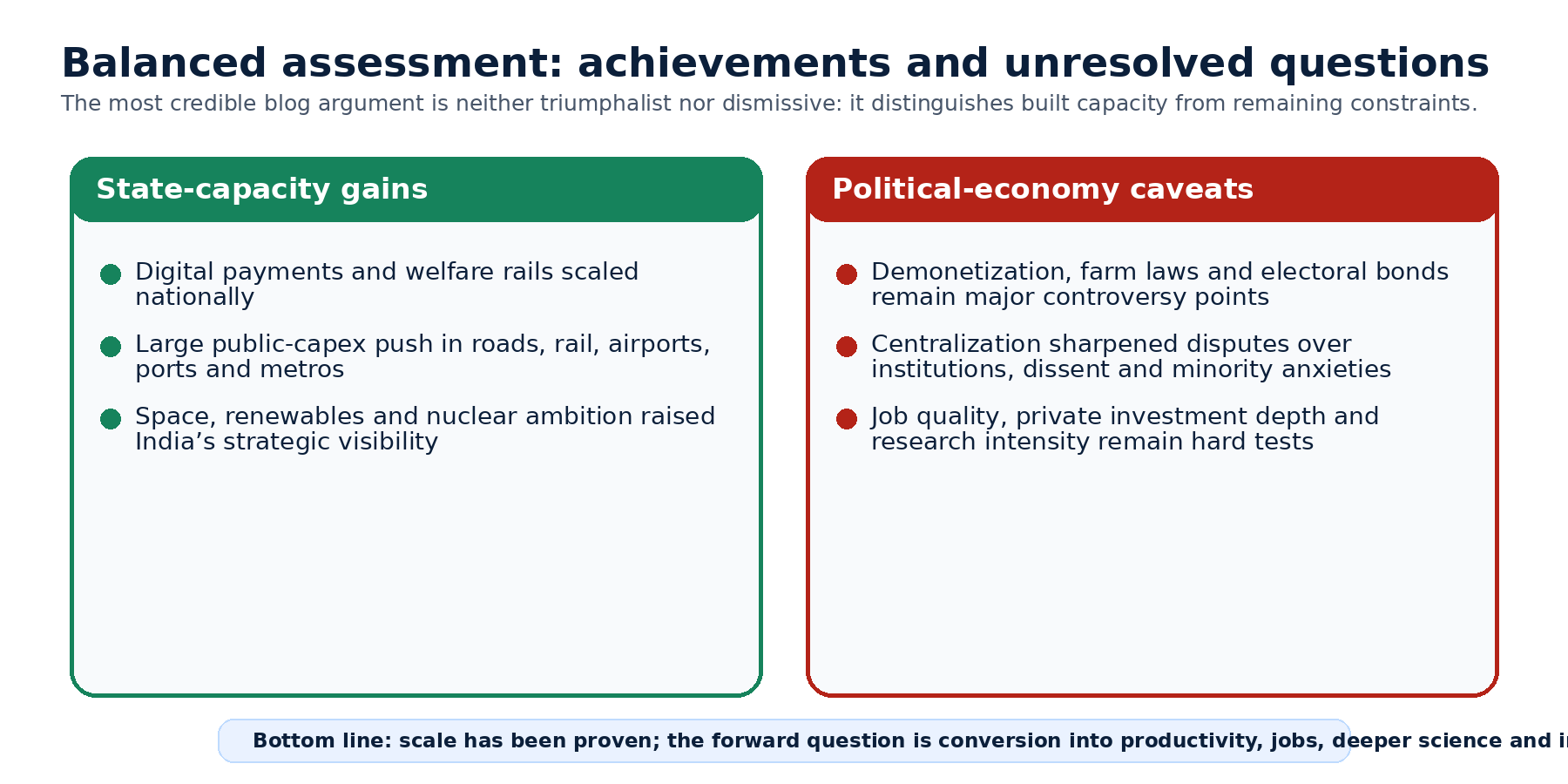
What has been proven is the Indian state’s ability to scale platforms. Payment rails, welfare rails, infrastructure rails and strategic-technology missions moved from fragmented capacity toward national operating systems. This is why the Modi era should be analyzed less as a collection of schemes and more as a redesign of execution capacity. [PIB UPI] [Roads] [ISRO]
What remains unresolved is the conversion problem. Scale must become productivity; capex must become private investment; digital inclusion must become household income growth; science missions must become research depth; and political continuity must remain compatible with institutional trust and pluralism. These are not minor objections. They are the difference between a high-visibility development state and a durable, innovation-led developed economy. [World Bank] [V-Dem]
The political-institutional critique should be included, but in a disciplined way. Article 370, CAA, farm laws, electoral bonds, media pressure and civil-liberties concerns are central to the period. Yet the 2024 election also demonstrated that electoral competition remains real and that even a dominant leader can lose unilateral parliamentary control. The most credible conclusion is therefore tension: stronger execution capacity alongside sharper disputes over institutional balance. [Reuters] [SC Observer] [V-Dem] [AP]
Conclusion
A final blog built from these drafts should lead with achievements without becoming promotional. The strongest sentence is not “India changed because of one leader,” but rather: under Modi, India accelerated a platform-based development state in which digital payments, welfare delivery, logistics, science missions and geopolitical confidence reinforced one another. That is a serious achievement. [PIB UPI] [ISRO]
The equally serious caution is that the second-order tests are harder than the first-order buildout. India must turn infrastructure into productivity, digital rails into broad-based income gains, welfare scale into human-capital depth, energy capacity into reliable decarbonized generation, and scientific symbolism into sustained research intensity. If those conversions occur, the Modi era will look like a foundation for developed-economy transition. If they do not, it will look more like impressive state construction with incomplete economic and institutional conversion. [IEA] [World Bank] [V-Dem]
That is the best-balanced conclusion: Modi strengthened India’s execution machinery and global visibility, while leaving unresolved the deeper questions of employment intensity, research depth, institutional trust and plural democratic legitimacy. The record is therefore large, consequential and contested - exactly the kind of record that deserves a rigorous, data-grounded blog rather than a partisan slogan. [PMO tenure]